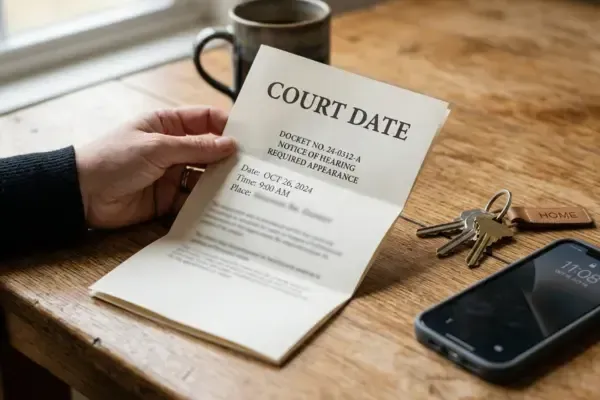
What Happens If Your Loved One Misses Their Court Date? | Bob Barry Bail Bonds
What Happens If Your Loved One Misses Their Court Date? The Honest Answer From a Daytona Beach Bondsman
You posted the bond. You paid the premium. Your loved one walked out of the Volusia County Jail. You exhaled for the first time in days.
And then life kicked back in — work, kids, stress — and somewhere in the back of your mind, a question started forming: What happens if they don't show up to court?
It's a question most families are afraid to ask out loud. But it's one of the most important questions in this entire process, and almost nobody in the bail bonds industry takes the time to answer it honestly.
So here it is — the straight answer, step by step, from a bondsman who has been doing this in Daytona Beach and Volusia County since 1978.
First: Why the Court Date Matters More Than People Realize
When a bail bond is posted, it creates a three-way legal agreement between the court, the defendant, and the bail bond company. Under Florida Statute 903.26, the bondsman is essentially promising the court: "This person will appear. And if they don't, we're financially on the hook for the full bond amount."
That's not a formality. That's a legally binding guarantee.
When the defendant walks out of jail, the clock starts. Every court date that gets missed triggers a specific chain of events — and the speed of that chain is something most families don't know about until it's already in motion.
Step 1: The Bench Warrant — It Happens the Same Day
If your loved one fails to appear at a scheduled court hearing, the judge does not wait to see if there's a good explanation. Under Florida law, the failure to appear is treated as automatic grounds for forfeiture, and the clerk enters it that same day.
The court immediately issues a bench warrant for the defendant's arrest. That warrant is active the moment it's entered. It does not expire. Law enforcement can act on it at any time — during a traffic stop, at a job, at home.
What this means practically: Your loved one is now a wanted person for failing to appear, on top of whatever the original charge was. Two problems instead of one.
Step 2: Bond Forfeiture — The Bondsman's Money Is Now at Risk
This is the part most families don't fully understand when they sign the paperwork at the bonding office.
When the defendant misses court, the bond is declared forfeited. That means the court claims the right to collect the full bail amount from the bondsman — not just the 10% premium you paid, but the entire bail. If bail was set at $20,000, the bondsman is now on the hook for $20,000.
Under Florida law, the clerk of court mails a forfeiture notice to the bondsman within 5 days of the failure to appear. Once that notice is mailed, the clock for what happens next begins running.
Florida law on forfeiture timing (§ 903.26):
• Forfeiture is entered automatically when the defendant fails to appear
• The clerk must notify the bondsman within 5 days of the forfeiture
• The bondsman then has 60 days from that notice to resolve the forfeiture
• If unresolved after 60 days, the forfeiture proceeds toward judgment
This is why the bondsman's role in a missed court date is not passive. Their money is at stake — which means they are highly motivated to help resolve the situation quickly.
Step 3: The 60-Day Window — Your Most Important Piece of Information
Here is what most families never get told, and what makes all the difference between this being a manageable problem and a financial disaster.
Florida law gives the bondsman a 60-day window after the forfeiture notice to resolve the situation before it proceeds to judgment. Within that window, the forfeiture can be discharged — meaning set aside — if:
•The defendant is returned to custody (surrendered or arrested)
•The defendant appears in court and a motion is filed to reinstate the bond
•The court determines it was impossible for the defendant to appear (documented medical emergency, incarceration elsewhere, etc.)
The court also has discretion to discharge the forfeiture if the defendant is returned and the bondsman pays any costs associated with returning them to Volusia County jurisdiction.
The key word here is speed. Every day that passes without action is a day closer to that 60-day window closing. Once it closes and judgment is entered, the path to resolution becomes significantly harder and more expensive.
Step 4: What the Cosigner Is Responsible For
If you co-signed the bond — which most family members do — you need to understand what your exposure looks like if the defendant fails to appear.
As the cosigner, you are responsible for:
•Helping locate the defendant so they can be returned to court
•Any costs the bondsman incurs in locating and returning the defendant
•Investigation costs, court costs, and attorney fees related to the forfeiture
•Potentially the full bond amount if the defendant is not found within the forfeiture window
This is not meant to frighten you. It's meant to be honest. Most people who co-sign a bond don't read the fine print, and the moment their loved one misses a court date, they get a very unwelcome education.
The good news: if you call the bondsman immediately, most of these consequences can be avoided or significantly reduced.
Step 5: What You Should Do Right Now If a Date Has Been Missed
If your loved one has already missed a court date — or you're worried they might — here is the exact order of operations:
1. Call the bondsman first.
Before you call an attorney, before you panic, call the bondsman. They are the party with the most immediate stake in resolving the forfeiture, and they can move fastest. At Bob Barry Bail Bonds, we answer 24 hours a day at (386) 258-6900.
2. Don't let the defendant run.
It sounds obvious, but the worst thing that can happen is for the defendant to go underground. Every day they're not located increases the cost and complexity of the situation — and your exposure as the cosigner.
3. Gather documentation if the miss was unintentional.
Medical records, a hospital stay, a documented emergency — these can support a motion to discharge the forfeiture on grounds of impossibility. Get that documentation together before the bondsman's attorney needs it.
4. Check the Volusia County court case status.
You can verify case details and court dates through the Volusia County Clerk of Courts. Knowing the current status of the case helps the bondsman and any attorney working the reinstatement.
5. Act within days, not weeks.
The 60-day window sounds long. It isn't — not when attorneys, courts, and paperwork are involved. Treat the first call as urgent, because it is.
A Note on Failure to Appear Charges in Florida
Depending on the original charge and the circumstances of the missed appearance, Florida law may allow the state to file an additional criminal charge for failure to appear.
For felony cases, a willful failure to appear can result in a separate third-degree felony charge. For misdemeanor cases, it can result in a first-degree misdemeanor charge.
This is why the "just reschedule it" mentality is so dangerous. A missed court date is not a scheduling inconvenience. In Florida, it can create a second criminal case on top of the first.
The Bottom Line
Missing a court date is serious — but it is not automatically the end of the road. Florida law builds in a resolution window for exactly these situations. The families who come out of it in the best shape are the ones who acted fast and called the right people immediately.
The bond getting posted was the beginning of the process, not the end of it. Knowing what happens next — before you need to know it — is what puts you in the best possible position.
Questions about a missed court date or upcoming court obligations in Volusia County?
Bob Barry Bail Bonds has been navigating the Volusia County court system since 1978.
We answer 24 hours a day — call (386) 258-6900 or visit daytonajail.com/contact.
Our office is located directly across from the Volusia County Branch Jail.
This is not just a transaction to us. If you have questions after the bond is posted, we're still here.